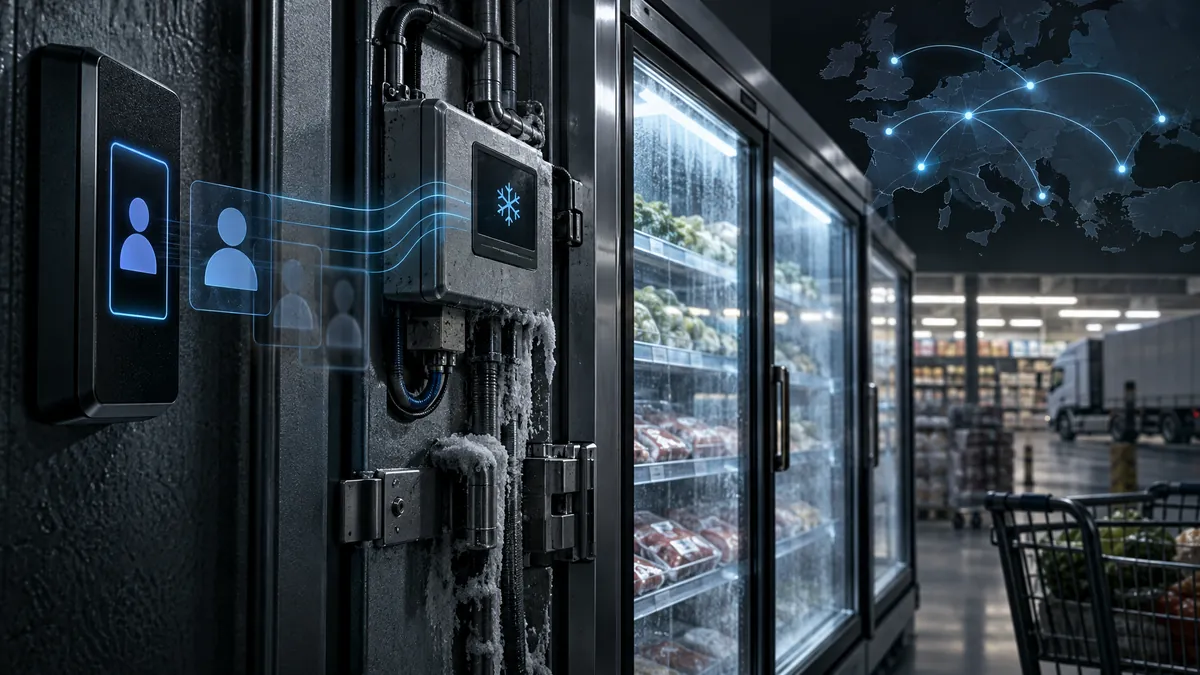
A second wave of cyberattacks changed refrigeration systems to defrost mode and spoiled food at European supermarkets. Reports described dozens of affected stores across seven countries, following an October wave that reached more than 700 locations. Internet-connected controllers, remote access, old firmware and weak or shared credentials are central concerns. No attacker has claimed responsibility, and the motive remains unknown.
What Happened
A second wave of cyberattacks affected refrigeration systems at supermarkets across Europe. An unknown actor appears to have gained access to connected controllers and switched systems into defrost mode. Temperatures reportedly rose to 50 degrees Celsius, or 122 degrees Fahrenheit, causing refrigerated food to spoil.
The latest wave was smaller than the first series of attacks in October. Reporting described dozens of supermarkets affected across seven European countries, including Belgium, Luxembourg, Estonia, Ireland, Sweden and Finland. One retailer said 15 of its 700 stores in Belgium were affected. The October attacks reached more than 700 retail and grocery stores, primarily in France, with additional impact in several other European countries.
No person or group has claimed responsibility for either wave, and the motive remains unknown. European authorities are investigating. The incidents have been associated with internet-connected refrigeration controllers from multiple manufacturers, but the precise attack path has not been publicly established.
The recurring technical concerns are familiar. Organizations often expose refrigeration controllers to the internet for remote maintenance and support. Older firmware may contain unpatched weaknesses. Default passwords, shared service codes and static credentials can also make unauthorized access easier, particularly when the same configuration is repeated across many sites.
Why It Matters
The attacks produced physical and financial consequences without targeting conventional office systems. Spoiled food creates direct inventory loss, cleanup work and operational disruption. It also shows that equipment treated as a facilities responsibility can be part of the organization’s cyber risk surface.
The same design pattern exists beyond supermarkets. Pharmaceutical storage, food distribution centers and industrial facilities use connected equipment to maintain specific environmental conditions. The evidence does not establish attacks across those sectors, but it shows why similar weaknesses could matter wherever temperature control is essential.
Scale is another concern. Repeated hardware, credentials and remote-access practices can allow one weakness to affect many sites. A controller that appears minor in isolation may become materially important when hundreds of locations use the same deployment model.
These systems may also sit outside normal IT visibility. That can leave security teams unaware of internet exposure, third-party access or outdated firmware until operations are interrupted.
What to Watch
The identity and motive of the attacker remain unresolved. Further findings from European authorities may clarify whether both waves share the same operator and which access methods were used.
Organizations should also watch for additional attacks against supermarkets or other temperature-dependent operations. Any expansion into pharmaceutical, distribution or industrial environments should be treated as a separate confirmed development rather than assumed from the current retail incidents.
Technical guidance from manufacturers and national response teams will be important, particularly for discontinued controllers and older firmware. Operators should verify their own models and configurations rather than assuming that every connected refrigeration product has the same exposure.
What Defenders Should Do
Asset discovery: Build an inventory of refrigeration and temperature-control systems, including model, firmware, site, owner, internet exposure and third-party support connection. Include equipment managed by facilities teams or contractors.
Exposure reduction: Remove direct internet access wherever possible. Where remote support is necessary, place it behind a virtual private network or centralized secure-access service with strong authentication and session tracking.
Credential hygiene: Replace default passwords, shared service codes and static credentials. Use unique credentials by site or system so that one compromise does not automatically scale across many locations.
Maintenance and segmentation: Apply supported firmware updates and isolate controllers from corporate and payment networks. For discontinued equipment, use compensating controls and plan replacement based on operational importance.
Operational detection: Monitor unexpected mode changes, temperature spikes and remote configuration events. Ensure store or facility staff know how to escalate abnormal behavior quickly and safely reverse unauthorized changes when procedures allow.
The Larger Lesson
Connected operational equipment should be governed according to the consequence of failure, not its appearance or ownership. A refrigeration controller may look like a small facilities device, but its failure can destroy inventory and stop essential processes.
The repeated attacks also show how ordinary weaknesses become systemic when organizations deploy the same remote-access pattern across many locations. Internet exposure, old firmware and reused credentials can turn a local device problem into a multi-site business event.
The durable lesson is to bring facilities technology into the same inventory, access-control, monitoring and incident-response disciplines used for other critical systems.