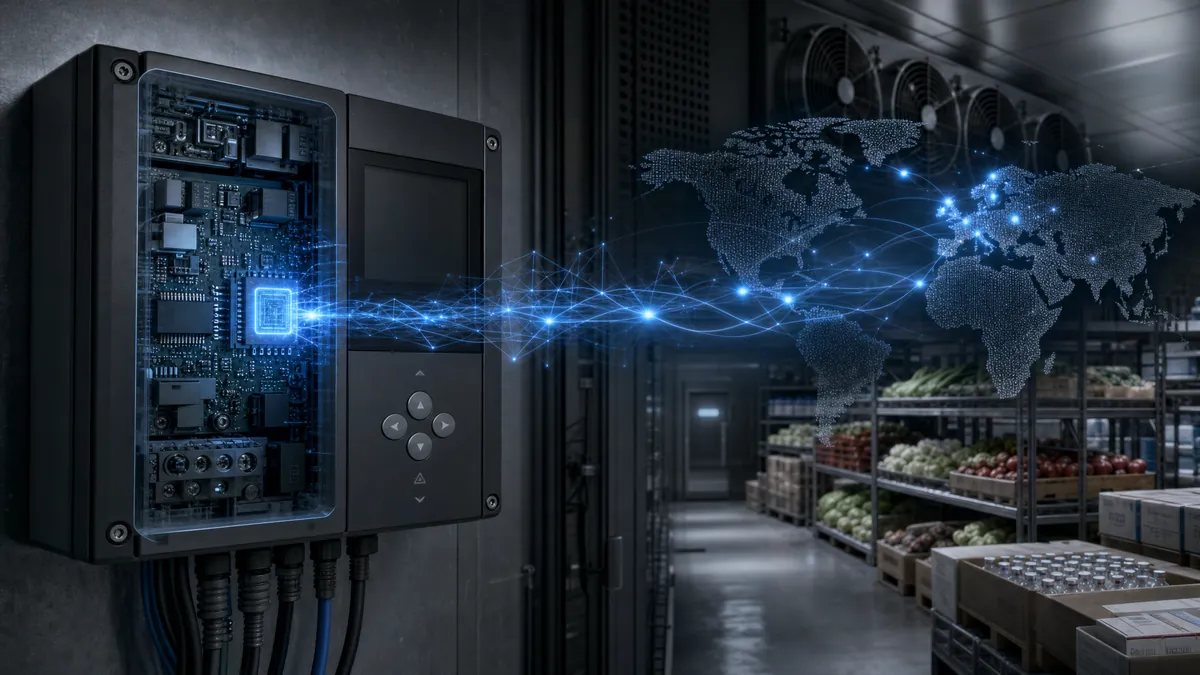
Food, medicine and store operations are at risk where refrigeration controllers remain reachable from the internet. Researchers found six paths to remote takeover in Danfoss AK-SM800A controllers, including one that worked on the latest firmware with strict session control enabled. Separate attacks have targeted exposed refrigeration controllers across Europe since October 11 and triggered defrost cycles. The reporting says the cause and attribution of those attacks remain disputed.
What Happened
Researchers found six pre-authentication remote code execution weaknesses in the Danfoss AK-SM800A supermarket refrigeration controller. The affected software includes every firmware version through 5.3.2, and no vulnerability identifiers had been assigned at the time of the reporting. The research team demonstrated a working root-level exploit on an older firmware version and withheld technical details while coordinating with Danfoss.
The weaknesses were found in code that handled web requests and copied data without adequate size checks. The controller software also lacked stack canaries and position-independent executable protections, making memory corruption easier to use. Because the main program runs as root, successful exploitation can provide full control of the device.
Danfoss added session controls in later firmware, and strict mode became the default from version 4.0. That setting blocks much of the unauthenticated web attack surface. However, the researchers reported another overflow in the component responsible for checking logins, and they said it still worked on the latest firmware even with strict mode enabled.
The findings arrived while exposed refrigeration controllers were already being attacked. Since October 11, waves of activity have targeted internet-reachable Danfoss and Copeland systems across Europe. Attackers reportedly started defrost cycles, with losses reaching tens of millions of euros. The exact operators and causes remain disputed. Early findings cited exposed administration pages and weak passwords rather than previously published software weaknesses, so the newly reported flaws should not automatically be treated as the cause of every incident.
Why It Matters
Refrigeration controllers manage physical processes. When they are compromised, the impact can move beyond data loss into spoiled food, damaged medicine, store disruption and equipment replacement. A controller that stops cooling or enters a defrost cycle can create losses before an information technology team has time to investigate.
The post-compromise risk is also significant. The controller does not use the i.MX6 chip’s secure boot capability. According to the research, an attacker with root access could install something that survives a factory reset, erase flash memory or load damaging firmware that bricks the device. Replacing hardware could leave freezers unavailable for days.
For business leaders, the central issue is not only whether a software flaw exists. It is whether operational equipment is reachable from the public internet. Hundreds of Danfoss devices and more than 1,000 Copeland and Dixell units were reported as visible online. That exposure gives attackers repeated opportunities to test passwords, administration pages and newly discovered weaknesses.
What to Watch
Watch for coordinated disclosure updates from Danfoss, including any firmware changes or additional mitigations. Because technical details are being withheld, organizations should not assume that the absence of public exploit instructions means exposed devices are safe.
The continuing level of internet exposure is another important indicator. If controllers remain publicly reachable, attackers may continue finding routes through credentials, administration interfaces or software weaknesses. Attribution should remain cautious because the reporting says the European incidents may not share one operator and their initial access methods are still debated.
What Defenders Should Do
Discovery: identify every refrigeration controller and management interface, including equipment connected through integrators, contractors or 4G modems. Do not rely only on the central asset inventory if outside parties manage connectivity.
Exposure reduction: remove controllers from the public internet. Place remote access behind a VPN, a private access point network or another private connection. A strict IP allow list can reduce immediate exposure, but the supplied guidance treats it as a short-term measure rather than a complete solution.
Configuration: enable strict session control where available. This blocks much of the unauthenticated web attack surface, although the research indicates that it does not eliminate every reported path.
Response readiness: prepare for the possibility that a compromised controller may require more than a factory reset. Because root access could support persistence or destructive changes, recovery planning should account for hardware replacement and prolonged loss of cooling. Coordinate security, facilities, store operations and refrigeration specialists before an incident occurs.
The Larger Lesson
Operational technology does not need to be large or complex to create material risk. A small controller can affect an entire store when it manages refrigeration for food or medicine.
The durable lesson is to treat internet exposure as a design failure for equipment that can change physical conditions. Individual software fixes matter, but repeatedly patching flaws will not solve the underlying problem if the controller remains publicly reachable. Isolation, controlled remote access and a complete inventory reduce the opportunity for both known and unknown attack paths.