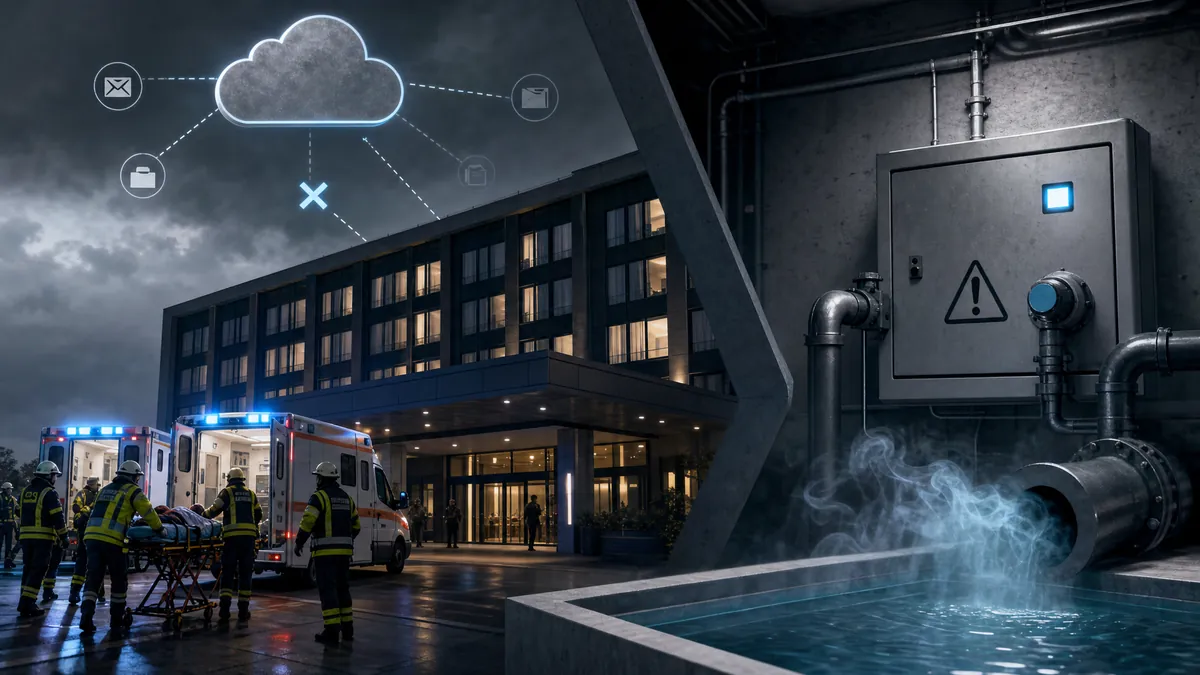
Fifteen hotel guests in Germany were poisoned after a chlorine warning failed during a Microsoft 365 outage. The hotel’s maintenance system relied on email to tell operators when chlorine levels became too high. Reporting says the outage prevented those messages from being delivered as chlorine rose. Emergency services sent 40 responders, four people went to hospital, and one remained under observation.
What Happened
A cloud service interruption became part of a physical safety incident at a hotel in Germany. The hotel used a maintenance safety system for its sauna and pool area that sent email warnings when chlorine levels became too high. During a Microsoft cloud outage, those messages could not be delivered, according to the supplied reporting. Chlorine levels rose without the expected email reaching the operators, and guests later reported health problems after visiting the pool.
The reported consequences were immediate. Thirteen guests initially complained of respiratory irritation, and the total number of affected people later rose to 15. German emergency services dispatched 40 responders. Four victims were taken to hospital, and one stayed for further observation. The pool was temporarily closed and later reopened.
The outage affected Microsoft services, including Outlook, from November 12 to 14. The reporting does not describe a final technical investigation into every part of the hotel’s maintenance environment. It does, however, identify a central design problem: the alert depended on email, and that warning path stopped working when the cloud service was unavailable.
That distinction matters. The cloud outage was not described as directly changing the chlorine level. It interrupted the mechanism intended to warn operators that the level was unsafe. A failure in a general-purpose communications platform therefore removed visibility from a safety process at the moment that visibility was needed.
The incident is notable because the outage was less disruptive overall than the widespread CrowdStrike-related failure in 2024, yet it still coincided with people being physically harmed. It shows that incident severity cannot be judged only by the number of computers, users or organizations affected. A smaller interruption can have a greater consequence when it sits inside a safety-critical workflow.
Why It Matters
Email is commonly treated as a dependable business utility, but this incident shows the risk of treating it as the sole control for a safety warning. Cloud platforms can be highly reliable while still experiencing outages. If an alarm has only one delivery path, the wider system inherits that path’s availability limits.
The exposure is not limited to hotels or pools. The durable concern is any connected or automated environment where a critical warning depends entirely on an internet connection, cloud platform or remote message. The more serious the consequence of a missed alert, the less acceptable a single communications dependency becomes.
For executives, the incident changes the framing of cloud resilience. This is not only an information technology availability question. It can become an operational continuity, customer safety and emergency-response question. A cloud dependency that appears minor on a system diagram may be carrying a warning that protects people or physical assets.
For risk and security teams, the case also highlights the difference between monitoring a cloud provider and engineering resilience around it. Knowing that a service is unavailable does not restore the alert that failed to arrive. The local process must continue to detect and communicate unsafe conditions even when the normal digital path is down.
The incident also illustrates concentration risk. Large providers offer dependable services at a scale that many organizations cannot reproduce internally, but a failure can affect many dependent processes at once. The relevant management question is not whether cloud services should be used. It is which functions must continue safely when those services are unavailable.
What to Watch
Organizations should watch for any further technical or operational findings that clarify how the hotel’s alerting and chlorine-management processes were connected. If a final review is published, the most useful details would be whether any local alarm existed, whether staff could see chlorine levels without email, and how quickly the loss of messaging was recognized.
The broader signal to monitor is whether cloud outages expose similar single-channel dependencies in other safety or industrial environments. A messaging interruption may appear routine until teams map the alerts that depend on it. Future cloud incidents should therefore be assessed not only by user access or productivity impact, but also by the critical processes that lose visibility.
Leaders should also watch whether resilience reviews lead to tested physical, analog or locally operated alternatives. A backup that exists only in a plan, or that staff do not know how to operate, will not provide meaningful protection during an outage.
What Defenders Should Do
Immediate action: inventory alerts connected to health, safety, physical operations and critical equipment. For each alert, document how the condition is detected, where the message is processed, how it reaches staff and what happens if the internet or cloud service is unavailable.
Resilience check: identify any warning that relies on one email provider or one remote communications path. Give priority to systems where a missed message could expose people, damage equipment or stop an essential process. The consequence of failure should determine the strength of the fallback.
Backup design: provide a physical or offline warning method that continues operating when cloud services fail. The source material specifically recommends physical or analog backups. Local servers and automation may also reduce reliance on a remote provider, although they require additional maintenance and remain vulnerable to local problems such as power loss.
Operational readiness: train staff to use the fallback and practise the procedure regularly. Confirm who checks the local system, who has authority to stop the affected operation and how the organization recognizes that the normal alert channel has failed. A backup that nobody understands is not an effective control.
Testing: simulate loss of internet access and cloud messaging without waiting for a real outage. Verify that unsafe conditions remain visible, staff receive a warning through the fallback, and the response does not depend on the unavailable service. Record any gap and assign an owner and completion date for corrective work.
The Larger Lesson
Digital convenience can conceal physical risk. A cloud email service may look like a supporting component, but its role changes when a safety process depends on it. At that point, messaging availability becomes part of the safety architecture.
The durable lesson is to design around consequences rather than technology labels. An organization may describe a system as email, cloud or automation, while the people affected experience it as a missing alarm. Critical workflows need independent ways to detect danger, communicate it and act when the normal path fails.
Resilience also requires more than duplicate technology. Staff must understand the fallback, practise it and have clear authority to respond. The safest design assumes that internet access, cloud services and local systems can each fail, then ensures that no single failure can silently remove the warning protecting people.