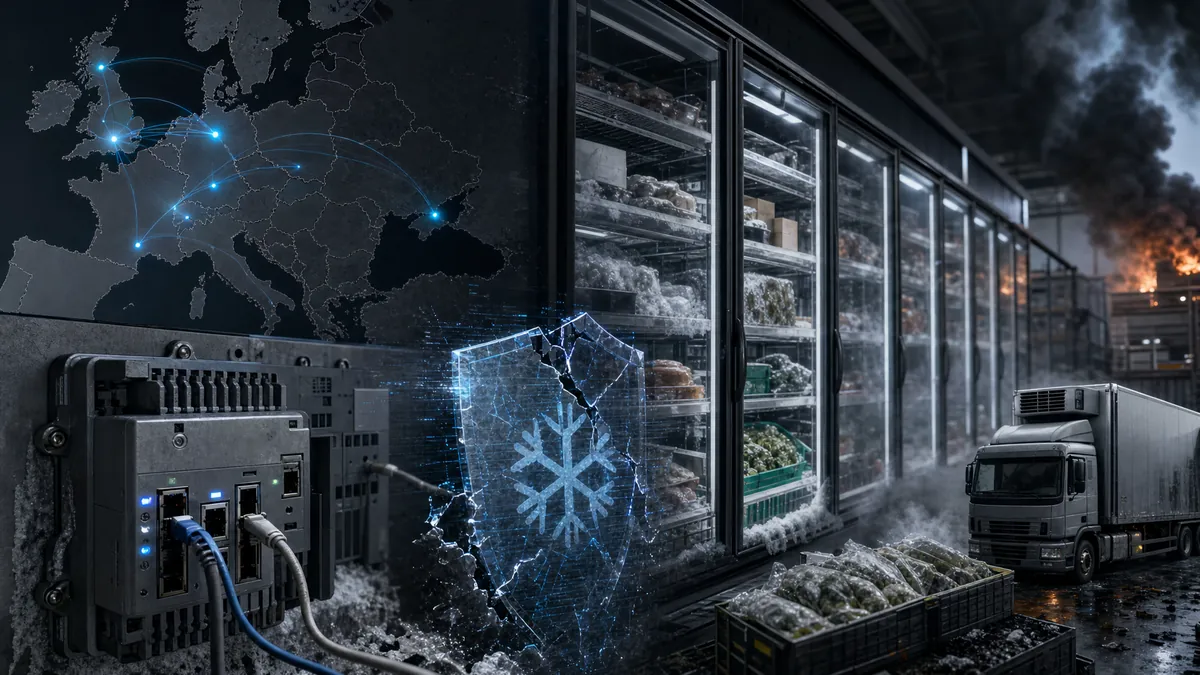
Cyberattacks on exposed refrigeration controls caused significant inventory losses and at least 15 reported fires. Attackers manipulated temperature settings, defrost schedules and other operating parameters at approximately 700 French retail locations during October, followed by incidents across several European countries in November. Internet-accessible systems from multiple refrigeration and temperature-control vendors are being targeted through weaknesses in authentication, configuration and software.
What Happened
Threat actors are targeting internet-accessible refrigeration management interfaces and industrial temperature controllers. The reported activity involves systems used to monitor and manage cooling equipment, including Danfoss AK-SM and AK-SC controllers, Copeland XWEB systems, Dixell XWEB systems and other remotely accessible refrigeration technology.
The attackers are exploiting a combination of software weaknesses, authentication problems and insecure configurations to gain unauthorized access. Once inside, they can alter temperature setpoints, defrost schedules and other operating parameters. Those are not cosmetic settings. They directly govern whether refrigeration equipment maintains safe temperatures and how it behaves during routine operating cycles.
The first reported wave began in France on October 11–12, 2026. Approximately 700 retail locations were affected. Attackers changed refrigeration configurations, including defrost parameters, and caused units to run at elevated temperatures. The incidents led to significant inventory losses and at least 15 reported fires.
A later wave on November 1–2 affected refrigeration systems in Belgium, Estonia, Finland, Ireland, Luxembourg, the Netherlands and Sweden. The spread across several countries shows that the risk is not confined to one retailer, one local network or one national market.
On November 5, CISA, the FBI, HHS, USDA and the U.S. Department of Transportation issued a joint warning about malicious cyber activity targeting industrial refrigeration and cold-chain monitoring systems globally. On November 13, Ireland’s National Cyber Security Centre disclosed six previously unknown pre-authentication remote code execution vulnerabilities affecting Danfoss AK-SM800A controllers. No confirmed security fixes were available at the time of that disclosure.
French authorities attributed the October attacks to nation-state actors. Separate reporting said French officials blamed the Iranian government and associated the activity with Shahid Kaveh, also known as the Cyber Av3ngers. Regardless of attribution, the access path described in the evidence is important for operators: internet-exposed controllers and weak access controls created an opportunity to manipulate normal equipment functions.
Why It Matters
This incident moved beyond data loss or temporary IT downtime. Altered refrigeration settings produced spoiled inventory, damaged equipment, operational disruption and reported fires. That combination makes the event relevant to executive leadership, facilities teams, safety personnel, operational technology teams, security operations and business continuity planners.
Cold-chain systems support grocery stores, warehouses, distribution centers and other organizations that depend on stable temperatures. A compromise can destroy products without encrypting a file or deploying ransomware. It can also create cascading costs through emergency repairs, store closures, product replacement and safety investigations.
The affected technology may sit outside traditional IT ownership. Refrigeration controllers are often installed for remote monitoring and maintenance, then left accessible for long periods. If they are not included in asset inventories, vulnerability processes and access reviews, defenders may not know which devices are reachable or who can change their configurations.
The incidents also demonstrate why operational impact should guide cyber priorities. A controller with limited data may still carry high business risk because it can change physical conditions. Security programs that rank assets only by the sensitivity of stored information can overlook systems capable of causing larger real-world losses.
Attribution does not reduce the immediate defensive requirement. The reported access methods involved weaknesses that could potentially be used by other actors. Organizations therefore need controls that address the exposed technology and its operating environment, not assumptions about one adversary’s intent or sophistication.
What to Watch
Operators should watch for further attacks against refrigeration and cold-chain systems in additional countries or sectors. Because the warning described global malicious activity, organizations should not assume that the reported European incidents define the full scope.
The six reported weaknesses affecting Danfoss AK-SM800A controllers had no confirmed fixes at the time of disclosure. Organizations using those systems should monitor official guidance and reassess exposure when updates or mitigations become available. Until then, reducing reachability and strengthening remote access are especially important.
Security and facilities teams should also watch for unexplained changes to temperature setpoints, defrost schedules and operating parameters. Unexpected heating or repeated defrost activity may indicate misuse, but operational staff should validate alerts against legitimate maintenance and equipment faults.
Further government or vendor reporting may clarify the affected configurations, access methods and indicators. Attribution may also develop, but organizations should avoid delaying remediation while waiting for complete certainty about who conducted the attacks.
Finally, leaders should watch for evidence that similar operational devices are exposed elsewhere in the business. Refrigeration may be the immediate focus, but the durable risk is remotely accessible equipment whose settings can affect inventory, safety or service delivery.
What Defenders Should Do
Immediate exposure review: Build or validate an inventory of refrigeration management systems, temperature controllers and remote monitoring interfaces. Identify which devices can be reached from the public internet and which third parties have remote access.
Network protection: Remove direct internet exposure wherever possible. Place remote access behind controlled, authenticated pathways and restrict management connections to approved users and systems. Separate operational refrigeration networks from regular user networks where the environment permits.
Access control: Replace default or shared credentials, use strong unique credentials and review administrator accounts. Confirm that former employees, contractors and service providers no longer retain access.
Configuration monitoring: Record approved temperature setpoints, defrost schedules and operating parameters. Investigate changes that do not match a documented maintenance activity or operational request. Preserve relevant device, network and authentication logs when suspicious activity appears.
Incident preparation: Coordinate security, facilities, safety and operations teams before an event. Define who can safely isolate remote access, restore known-good settings and verify that equipment has returned to normal operation. A cyber response must not create additional safety or product risks.
Vulnerability management: Review vendor and government guidance for the equipment in use. Where fixes are unavailable, prioritize compensating controls such as network isolation, restricted management access and closer monitoring. Validate changes carefully because these systems control physical processes.
Business response: Include spoilage, equipment damage, service interruption and fire risk in incident exercises. Ensure that escalation criteria reflect physical and financial consequences rather than waiting for evidence of stolen data.
The Larger Lesson
Operational technology does not need sophisticated malware to create serious harm. If an attacker can reach a legitimate management interface and change legitimate settings, the equipment itself can become the mechanism of disruption.
That changes how organizations should define critical assets. A device may hold little sensitive information yet still control inventory conditions, business continuity and physical safety. Risk assessments should therefore consider what a system can do, not only what data it stores.
The incident also highlights the cost of convenience-driven exposure. Remote access can make maintenance more efficient, but direct internet reachability, weak authentication and insecure configurations turn that convenience into an attack path. The correct response is not necessarily to eliminate remote management, but to make it deliberate, restricted and visible.
Finally, cyber resilience for physical operations requires shared ownership. Security teams may understand networks and identity, while facilities teams understand the equipment and safe operating limits. Neither can manage this risk alone. Organizations that connect those disciplines before an incident will be better positioned to detect unauthorized changes, contain access and restore operations without making the physical situation worse.