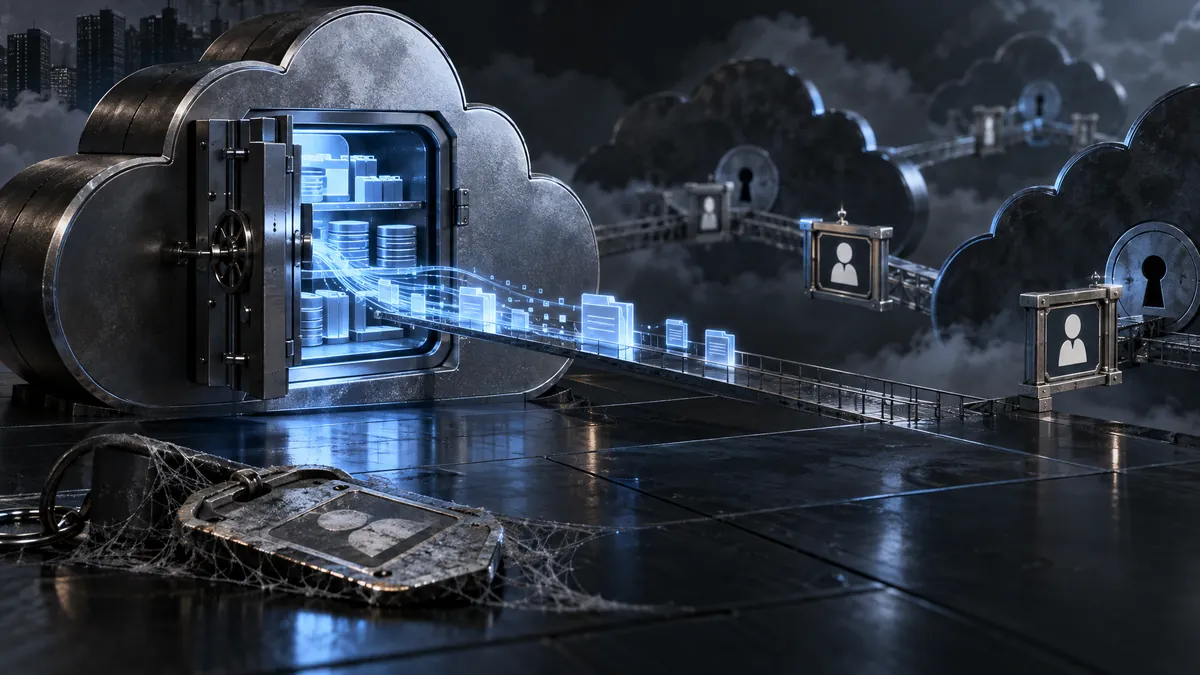
Customer data was stolen after attackers used compromised credentials linked to Qubole’s AWS account to assume trusted roles in other organizations’ cloud environments. The campaign affected over a dozen organizations and ran from October 14 to October 26. Attackers enumerated resources, collected secrets and configurations, and exfiltrated data from S3 buckets. Dormant Qubole roles left in place after the platform was no longer used widened the opening.
What Happened
Attackers used compromised identity and access management credentials associated with Qubole’s AWS account to enter customer cloud environments. Qubole is a cloud data-processing platform that can use cross-account roles created by customers. Those roles allow Qubole’s AWS account to assume temporary access inside a customer environment without requiring the customer to hand over a permanent access key.
In this campaign, that normal trust relationship became the path of entry. Activity began on October 14 and continued through October 26. The attackers used the compromised Qubole-linked credentials to assume customer-managed integration roles, enumerate cloud resources, collect secrets and configurations, and access data. More than a dozen organizations were reportedly affected.
The campaign was made more effective by roles that remained active after organizations had stopped using Qubole. These dormant connections still trusted the vendor account and, in some cases, retained broad read access. Once inside, the attackers searched common AWS locations for credentials and other secrets. They used TruffleHog to test credentials and then exfiltrated information from S3 storage. In some cases, entire buckets were downloaded in a single session.
The observed activity appeared opportunistic rather than focused on a specific type of information. Investigators had not attributed the campaign to a known group and did not know how the stolen data would be used. A separate campaign between October 8 and October 11 tested customer-owned AWS keys associated with Qubole integrations and compromised a small number of environments, but investigators could not definitively connect that activity to the later campaign.
Why It Matters
This was not described as a compromise of AWS services. The attack succeeded by abusing credentials associated with a third-party provider and roles that customers had configured to trust that provider. The distinction matters because cloud platforms can operate as designed while customer data is still exposed through an overly broad or outdated trust relationship.
Cross-account roles are widely used because they give software providers controlled access to customer environments. They also create a supply-chain dependency. If the trusted provider’s credentials are compromised, every customer role that still accepts that identity becomes a potential doorway. The risk grows when permissions are broad or when integrations remain active after the service is retired.
The data exposure may extend beyond files in S3. The attackers searched locations used for secrets and configurations, including Lambda, Secrets Manager and SSM Parameter Store. Credentials discovered there could create additional access paths into cloud or identity services. That means incident scope cannot be measured only by the data that was visibly downloaded.
What to Watch
Affected organizations still need to establish the complete scope of access and data theft. Investigators have not identified the actor, its motivation or how the stolen information may be used. Any later misuse of exposed credentials or data could expand the incident beyond the original cloud sessions.
Teams should also watch for findings that connect or separate the October 8 to October 11 activity from the campaign observed between October 14 and October 26. Investigators currently cannot definitively link them. Organizations that previously used Qubole should not assume they are safe simply because the integration is inactive in daily operations; the relevant question is whether the associated cloud trust still exists.
What Defenders Should Do
Discovery: inventory every current and former third-party integration that can assume roles in the cloud environment. Search specifically for Qubole-related trust policies and identify roles that remain active despite the platform no longer being used. Remove roles and trust relationships that have no current business owner or operational requirement.
Investigation: review CloudTrail records from October 1 onward for role-assumption events associated with Qubole’s AWS account, including activity from non-AWS addresses. For every suspicious role session, trace subsequent access to S3, Secrets Manager, SSM Parameter Store, Lambda and other reachable services. The investigation should establish both what the attacker accessed and what the assumed role had permission to access.
Containment: revoke active role sessions and rotate every secret, parameter, access key and Lambda environment variable that an affected role could read. Rotating a credential alone may not terminate temporary sessions that have already been issued, so session revocation is a separate step. Permissions should be reduced to the minimum required before any integration is restored.
Prevention: make cloud trust removal part of vendor offboarding and service retirement. Add regular reviews for cross-account roles, external identities and dormant integrations. Where appropriate, narrow trust policies with conditions such as approved source addresses and ensure each third-party role has a named internal owner.
The Larger Lesson
Cloud supply-chain risk often hides in relationships rather than software packages. A role created during onboarding can remain powerful years after attention has moved elsewhere. If that role still trusts a provider and can read sensitive resources, the organization remains exposed to events affecting the provider’s identity.
The durable control is lifecycle management. Creating access, reviewing it, reducing it and removing it must be treated as one continuous process. An integration is not fully retired until its identities, permissions, secrets and trust policies are gone.